.png)
The role of partitions is to divide the interior of a building into rooms. Unlike internal load-bearing walls, which, in addition to carrying structural loads, also perform this function, they do not need to be as massive.
However, for their construction, it is always necessary to choose a solid material and pay special attention to the appropriate connection with structural partitions. Partitions do not carry any structural loads on the building, only those that directly affect their surface - furniture, decorative elements, or audio-video equipment mounted on them.
This does not mean that their placement can be arbitrary. The location of each wall should be specified in the house design.
Changes during the finishing of the building and its use are possible, but should be consulted with a designer. This is especially true for brick walls, the weight of which can exceed even 200 kg/m. This is a significant load on the ceiling, so before adding it, its strength should be checked. If necessary, the designer may order its reinforcement at the wall location.
When this is not possible, a lightweight partition made of plasterboard, such as a skeleton, remains an option. This technology is very popular not only because of its low weight but also because of its speed. Other types of partitions, which we will characterise below, include aerated concrete walls, acoustic partitions, and barriers made of glass blocks.
Acoustic insulation of internal walls
1. PARTITION - TRADITIONAL BRICK
The most common method of erecting partitions over the years, namely brick construction, remains very popular.
This technology involves the even laying of bricks and bonding them with a cement-lime mortar. These elements are usually 25 x 12 x 6.5 cm. Laying bricks is not difficult, but there are a few things to keep in mind. Apart from the obvious - maintaining verticality - it is important to lay roofing material under the first layer of bricks. On the other hand, at the top, between the ceiling and the partition, a gap of about 1-4 cm should be left, which is tightly filled with elastic material, Macsound prof 40.
The purpose of the gaps is to compensate for ceiling deflections. Another important element is the artistic connection of the partition with the previously erected load-bearing walls. This can be done in three ways:
• The first consists of placing reinforcement bars with a diameter of 6-8 mm at the raw stage, and then embedding them in the joints of the partition during its laying. They should be spaced every 30-50 cm.
• The second method - the so-called patch - in the load-bearing walls leftare cavities - nests for partition bricks.
• Another method is cutting a vertical groove in the load-bearing wall a few centimetres deep and the width of the partition brick, and placing the erected wall in it. Attention! Brick partitions of small thickness (6-7 cm) and more than 5 m in length require reinforcement with reinforcing bars with a diameter of 6 mm, laid in every second joint. Additionally, lintels are made in door openings. They can be made of reinforced concrete poured into formwork, in the form of a ready-made reinforced concrete beam, or from brick reinforced with steel beams laid in the joints.
A brick partition is very strong and has very good acoustic parameters. This most traditional method of wall construction has many advantages. First of all, stone partitions are very strong. You can hang heavy kitchen cabinets or other equipment on them without any worries. Additionally, they have very good acoustic parameters.
The soundproofing coefficient of a 15 cm thick brick wall (including plaster) is 47 dB.
Unfortunately, such a construction also causes a significant load on the ceiling - 1 m of brick wall weighs up to 250 kg. The mass can be reduced by 30% if a full opening is used instead of brick. However, it should be noted that such a wall will be less effective in sound attenuation. Another disadvantage of this technology is the labour intensity. The construction process extends the time required for the mortar and plaster to dry, which is usually used for such a partition.
2. Partition wall - cellular concrete partition from aerated concrete blocks.
The technology of wall construction in this option is similar to the previous one. It also consists of masonry, but precise blocks can also be joined with thin joints, using adhesive instead of cement-lime mortar. However, you need to hire an experienced specialist who will perform the masonry very carefully.
While in the traditional method of masonry, where the joint is 10-15 mm, you can afford to make corrections when erecting the partition, here there is no room for errors. The main thing is to perfectly align the first layer of blocks, otherwise, irregularities will spread throughout the wall.
Walls made of aerated concrete blocks have many advantages. The biggest of them is the small mass - about 50 kg/m, which is even five times less than in the case of solid brick walls.
Despite the lower weight, the blocks are larger in size than bricks, which speeds up masonry. Additionally, they are easy to process, which facilitates the erection of partitions of unusual shapes.
Aerated concrete blocks have many advantages.
Акустическая панель EcoSound Pattern толщиной 50 мм обеспечивает высокое звукопоглощение и подходит для использования в студиях, домашних кинотеатрах и офисах.
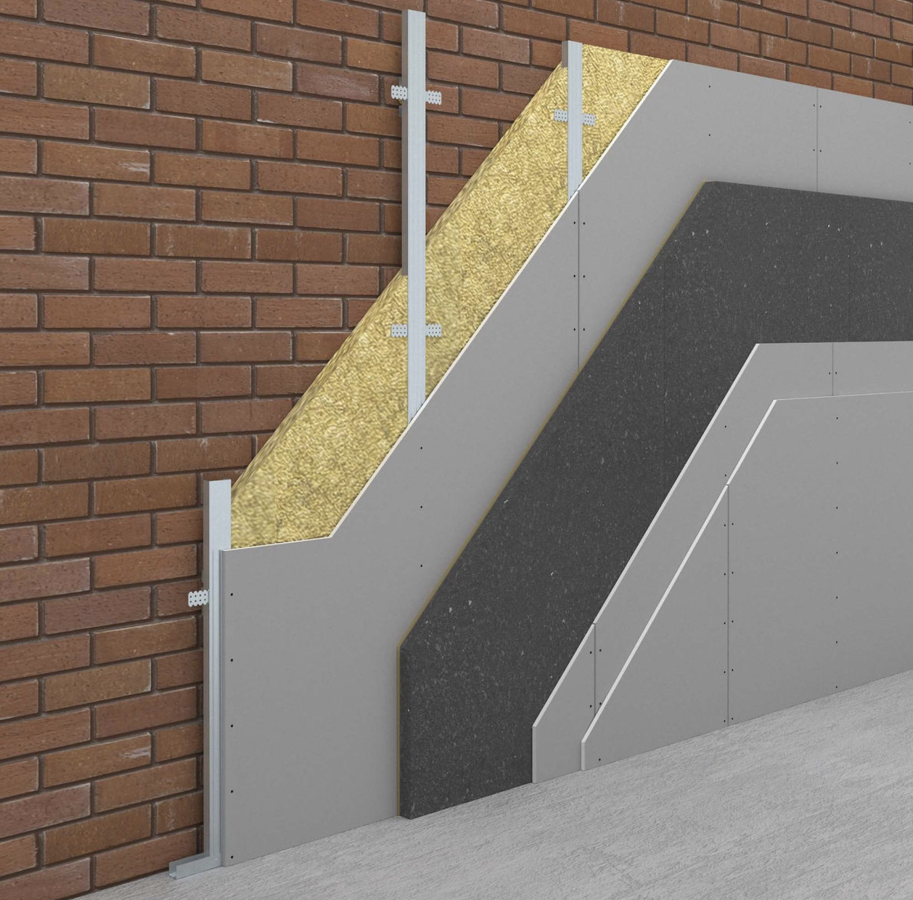
?ли другого оборуования.Вы также можете выбрать совершенно другой материал, например, древесно-стружечные плиты. Крепкие плиты также рекомендуются, если вы планируете отделать стену тяжелой облицовкой, например, керамической плиткой. 4. Скептическая сторона – защита стен от шумаКак уже упоминалось, типичные каркасные стены не являются эффективным барьером от шума. Если мы хотим сделать звукоизоляцию помещения, то стоит сделать акустическую стену.Технология его реализации аналогична описанному выше случаю. Конструкция состоит из стальных профилей, прикрепленных к полу, стенам и потолку (обязательно скрепленных акустической изоляционной лентой macsound prof 5 мм) и опорных профилей. Эти элементы, однако, должны быть шире, чем у типичной каркасной стены.Наполнителем также является Macsound prof 40 мм, который имеет очень хорошие акустические параметры, в то время как корпус рамы отличается. Двойная обшивка изготавливается из гипсокартона, желательно особой акустической разновидности.
Таким образом, мы получим стену с акустическими параметрами, похожими на кирпичную перегородку такой же ширины. Еще лучшую звукоизоляцию характеризуют двухпанельные барьеры с двумя стойками с полями, заполненными Macsound prof 40 мм.
В этом варианте стойки должны быть разделены дополнительным слоем Macsound prof, например, толщиной 4 см.
Такая стена не только очень тихая, но и устойчива к механическим повреждениям и долговечна. Вы можете загрузить его более тяжелой мебелью без страха. Однако такое усиление перегородки связано с дополнительной нагрузкой на потолок, что следует учитывать при планировании.Типичная скелетная стена имеет много преимуществ, но есть один существенный недостаток - она не является эффективным барьером против шума. Для улучшения его акустических параметров следует использовать двойные гипсокартонные панели или две рамы с Macsound prof 40 мм. 5. Перегородка из стекла – оригинальное люкс решениеСхема построения перегородки из стеклянных блоков.
Это очень оригинальное предложение, позволяющее не только разделить пространство на комнаты, но и получить интересные декоративные эффекты. Стена из стеклянных блоков, также является способом освещения интерьера.
Работа состоит из соединительных блоков со специальным раствором на основе белого цемента. Швы должны быть заполнены совместным раствором. Постоянная ширина стыков позволяет сохранить пластическую дистанцию крестовины. Для того чтобы стена поддерживала достаточную же
For stability, reinforcement is necessary. Therefore, reinforcement bars with a diameter of 8 mm are placed in the vertical and horizontal joints. The spacing should be adapted to the dimensions of the partition.
A wall made of glass blocks not only looks very original but also allows light to illuminate the room.
Attention! A wall made of glass blocks must be separated from other partitions. A gap of 1-2 cm should be filled with mounting foam and covered with a decorative strip.
In addition to the aforementioned advantages, it is also worth choosing a partition made of glass blocks due to its very good soundproofing (40-45 dB) and overall water resistance. Such a wall can also be an element of room arrangement — for example, if we decide to separate only a fragment of the interior.